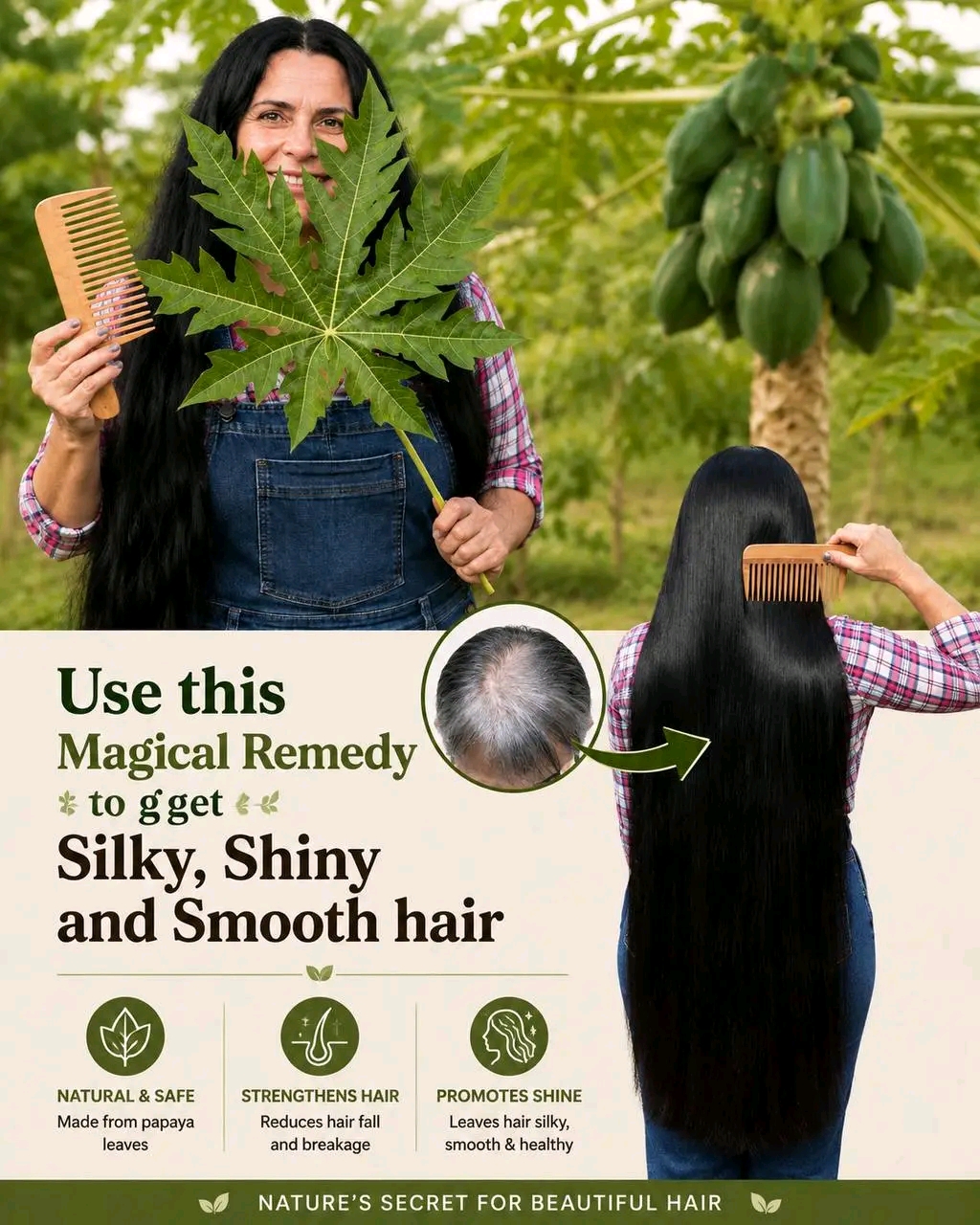
Papaya Leaves Trigger a Scalp Reset That Wakes Up Weak Hair — What the Evidence Really SaysPapaya leaves are becoming a popular ingredient in homemade scalp treatments.Videos and social-media posts claim that crushing fresh papaya leaves, turning them into a rinse, or mixing them with oil can:“Reset” the scalp.Wake up weak hair follicles.Stop shedding.Thicken thinning areas.And even regrow hair naturally.Papaya (Carica papaya) certainly contains biologically active plant compounds, and papaya-derived ingredients have been investigated for numerous potential uses.But there is a major difference between a plant containing interesting compounds and a treatment being proven to regrow human hair.At present, there is not good clinical evidence showing that ordinary papaya-leaf rinses can reactivate dormant follicles or reliably reverse common forms of hair loss.The American Academy of Dermatology (AAD) emphasizes that effective treatment for hair loss begins by identifying the cause, because hereditary thinning, excessive shedding, alopecia areata, traction alopecia, scalp disease, nutritional problems, and scarring hair loss require very different approaches.⚠️ Important Safety NoteThis article is for general educational purposes and is not a substitute for diagnosis or treatment from a dermatologist or other healthcare professional.Papaya-leaf preparations are not proven treatments for baldness or alopecia.Plant-based does not automatically mean irritation-free. Papaya contains biologically active enzymes, including papain-related proteins, and papain is a known allergen. Allergic reactions are possible in susceptible people.If you experiment with a cosmetic papaya-containing scalp product, patch-test it first and stop if you develop burning, swelling, significant itching, hives, or worsening irritation.Rapid hair loss, round bald patches, scalp pain or burning, heavy scaling, loss of eyebrows, or shiny/scar-like areas should be evaluated rather than repeatedly treated with homemade remedies.🌿 What Are Papaya Leaves?Papaya leaves come from the same tropical plant that produces papaya fruit.They contain numerous naturally occurring compounds, including enzymes and plant phytochemicals.This makes them scientifically interesting.But an ingredient being biologically active does not automatically mean:It stimulates human hair follicles.It blocks genetic hair loss.It increases hair density.Or it regrows permanently lost hair.Those claims require human clinical evidence.And that’s where the popular papaya-leaf hair-growth story becomes much weaker.🔄 What Does a “Scalp Reset” Actually Mean?“Scalp reset” is not a medical diagnosis or recognized dermatological treatment.Usually, people use the phrase to describe a scalp that feels:Cleaner.Less oily.Less coated with styling products.More comfortable.Or refreshed after washing.Those changes can certainly make hair feel and look better.But they should not be confused with changing the biological hair-growth cycle.Cleaning the scalp does not automatically switch dormant follicles back on.💇 Hair Follicles Don’t Have a Reset ButtonHair grows in cycles.Follicles move through periods of:Growth.Transition.Rest.And shedding.Many factors can disrupt that process.For example, hair loss may be related to hereditary pattern hair loss, alopecia areata, tight hairstyles, illness, major physiological stress, hormonal changes, scalp disorders, nutritional problems, or medications.Because the causes differ, one homemade leaf rinse cannot realistically treat all thinning hair.📊 Papaya Leaves & Hair: Claims vs. EvidenceClaim What we currently knowPapaya contains biologically active compounds YesPapaya-derived ingredients can be used in cosmetics YesA papaya scalp product may make hair feel refreshed PossiblePapaya leaves “detox” hair follicles Not establishedPapaya leaves wake dormant follicles Not establishedPapaya leaves reverse genetic baldness No good clinical evidencePapaya leaves cure alopecia NoPapaya leaves regrow hair within days No evidencePapaya can cause irritation/allergy in some people PossibleFinding the cause of hair loss matters Yes🌱 Could Papaya Make Hair Look Healthier?Possibly—but appearance and growth are two different things.A good hair-care routine can make hair appear:Smoother.Less frizzy.Less dry.Shinier.More manageable.And sometimes fuller.Reducing breakage can also help preserve existing length and density.AAD recommends gentle shampoo, moisturizing conditioner, leave-in conditioner or detangler, and minimizing damaging heat for people experiencing hair loss because thinning hair is fragile and easily damaged.Those changes may make weak-looking hair appear healthier without creating new follicles.🧴 Is Papaya Leaf Shampoo Different From Homemade Leaf Juice?Yes.A professionally formulated cosmetic product and crushed leaves mixed in a kitchen are not equivalent.Commercial products may control:Concentration.pH.Preservation.Stability.And microbial contamination.A homemade water-rich leaf mixture does not automatically have these safeguards.So if someone wants to experiment with papaya cosmetically, a properly formulated hair product is generally more predictable than storing homemade leaf juice for days.⚠️ Don’t Assume Stronger Means BetterA common mistake with natural remedies is increasing the concentration when results don’t appear quickly.Someone begins with a few leaves.Then doubles the amount.Then leaves the mixture on overnight.Then adds:Essential oils.Onion juice.Garlic.Lemon.Or other irritating ingredients.This does not necessarily improve effectiveness.It may simply increase the chance of scalp irritation.An inflamed scalp is not evidence that hair follicles are “waking up.”🔥 Burning Does Not Mean Hair GrowthIf a papaya-leaf mixture causes:Burning.Intense tingling.Persistent itching.Redness.Swelling.Or painful irritation,wash it off.Do not interpret the sensation as increased circulation or follicle activation.Papaya-derived papain is biologically active, and papain is recognized as an allergenic protein.Your scalp does not need to hurt for a treatment to work.🧪 Patch-Test FirstIf you’re trying a new cosmetic papaya hair product, use a small amount first according to the product directions.Watch for:Redness.Burning.Itching.Swelling.Rash.Or worsening scalp discomfort.If a reaction develops, stop using it.People with known papaya or latex-related allergies should be especially cautious with papaya-derived preparations.💆 What About Scalp Massage?A gentle scalp massage can feel relaxing.It may also help distribute shampoo or a cosmetic scalp product.But vigorous scratching is unnecessary.Use fingertips rather than fingernails.A massage should not:Scratch the scalp.Cause bleeding.Pull out hair.Or create pain.More aggressive stimulation does not automatically produce more hair.🧬 What If the Problem Is Genetic Hair Loss?This is one of the biggest limitations of papaya remedies.Hereditary hair loss can gradually produce:A widening part.Thinning over the crown.A receding hairline.Thinning temples.Or a growing bald spot.Papaya leaves have not been established as a treatment for hereditary pattern hair loss.AAD identifies topical minoxidil as an evidence-based treatment that can help some people with early hair loss. When it works, visible results generally require patience—often around 6 to 12 months.That timeline alone should make claims of dramatic regrowth from a leaf rinse in seven days questionable.⏳ Real Hair Growth Takes TimeHair growth is slow.Even established treatments do not normally produce dramatic new density overnight.AAD notes that minoxidil can take approximately 6–12 months to show results in people who respond.So photographs claiming:“Papaya leaves regrew all my hair in five days”should be viewed cautiously.Differences in:Lighting.Hair angle.Wet versus dry hair.Hair fibers.Styling.Camera exposure.And hairstylecan dramatically change how dense hair appears.🎀 Don’t Ignore Tight HairstylesSometimes the biggest improvement has nothing to do with adding another ingredient.Repeated tension from:Tight ponytails.Tight braids.Cornrows.Extensions.Tight buns.Or other pulling hairstylescan cause traction alopecia.AAD warns that prolonged pulling can eventually lead to permanent hair loss.If your hairstyle hurts, pulls strongly, or repeatedly causes scalp tenderness, loosen it.A papaya rinse cannot compensate for daily mechanical damage.🔥 Heat Can Also Work Against YouHair that is already thinning tends to be fragile.AAD recommends limiting:Flat irons.Curling irons.Hot combs.And excessive blow-dryer heat.It also specifically advises against hot-oil treatments for fragile thinning hair.You do not need to heat a papaya mixture or oil until it is hot to “open the follicles.”Hair follicles do not need to be opened this way.🥚 Nutrition Still MattersHair is strongly influenced by overall health and nutrition.Adequate dietary protein matters.A balanced diet may include foods such as:Eggs.Fish.Beans.Lentils.Plain yogurt.Poultry.Nuts.Seeds.Whole grains.Vegetables.And fruits.But supplements should not automatically be added simply because hair is thinning.AAD warns that getting excessive amounts of certain nutrients can actually worsen hair loss.If a deficiency is suspected, testing and targeted treatment are preferable to randomly taking multiple “hair-growth” supplements.🩺 Sometimes Hair Loss Is a Medical ClueHair shedding may occur after:Major illness.Surgery.High fever.Significant weight loss.Pregnancy.Severe stress.Or other major changes in the body.Other cases may involve:Thyroid problems.Nutritional deficiencies.Hormonal conditions.Autoimmune disease.Scalp infections.Or medications.AAD notes that dermatologists may use blood testing or scalp biopsy when a disease, deficiency, hormonal imbalance, or infection is suspected.That is why persistent hair loss deserves more than experimenting with different leaves.🌿 A Safer “Scalp Reset” RoutineIf your scalp simply feels oily, coated, or uncomfortable, you don’t need an aggressive detox.Try a simpler routine.Use a gentle shampoo appropriate for your scalp.Apply conditioner primarily to the hair.Use a leave-in conditioner if breakage is a problem.Avoid excessive heat.Wear looser hairstyles.Avoid scratching.Introduce only one new scalp product at a time.And if you use a papaya-containing cosmetic, patch-test it first.AAD’s hair-loss guidance emphasizes gentle cleansing and conditioning because fragile hair can be easily damaged.📅 A Better 30-Day Hair ExperimentInstead of asking:“Did papaya wake up my follicles?”measure things you can actually observe.Day 1Take clear photographs of:Your hairline.Temples.Part.Crown.Use the same lighting and camera distance.During the monthUse gentle shampoo.Condition regularly.Reduce high heat.Avoid tight hairstyles.Eat adequate protein.Avoid aggressive scalp scratching.Use only one new cosmetic treatment at a time.Day 30Repeat the photographs under identical conditions.Look for:Reduced breakage.Less irritation.Improved softness.Better manageability.Less excessive shedding.Do not expect a dramatic transformation in follicle density within a few weeks.🚫 10 Common Papaya-Leaf Hair Mistakes1. Calling papaya a proven hair-regrowth treatment.Human clinical evidence does not currently establish ordinary papaya-leaf treatments for hair regrowth.2. Expecting results within days.Even established hair-loss treatments generally require months.3. Believing burning means follicles are activating.4. Leaving a strong homemade mixture on overnight.5. Storing fresh leaf-and-water mixtures for long periods.6. Mixing papaya with lemon, garlic, onion, and multiple essential oils.7. Ignoring tight hairstyles.Repeated tension can eventually cause permanent traction alopecia.8. Using very hot oils or excessive heat.AAD advises against hot-oil treatments for fragile thinning hair.9. Taking random megadose hair supplements.Excessive amounts of certain nutrients can worsen hair loss.10. Treating progressive hair loss without determining its cause.🚨 When Hair Loss Needs a DermatologistConsider professional evaluation if you notice:Sudden heavy shedding.Round or irregular bald patches.Rapidly widening part.Progressive receding hairline.Hair loss beginning at the center or crown with scalp symptoms.Loss of eyebrows or eyelashes.Persistent scalp burning or pain.Heavy scaling or crusting.Pus or sores.Smooth, shiny, scar-like bald areas.Hair loss accompanied by unexplained fatigue, weight changes, or other new symptoms.Some forms of hair loss can become permanent if treatment is delayed. AAD specifically notes that early diagnosis and treatment improve the chances of preventing further loss in several conditions.❓ Frequently Asked QuestionsDo papaya leaves grow hair?There is currently insufficient good clinical evidence showing that ordinary papaya-leaf treatments reliably regrow human scalp hair.Can papaya leaves wake dormant follicles?That claim has not been established in human clinical trials.Can papaya make hair look healthier?A well-formulated cosmetic product may improve the way the scalp or hair feels, but healthier-looking hair is not necessarily new hair growth.Can papaya leaves cure baldness?No. They are not an established treatment for hereditary baldness or other major forms of alopecia.Can I leave papaya leaf juice on overnight?There is no established hair-growth advantage to prolonged exposure, and stronger or longer exposure could increase irritation. A properly formulated cosmetic product used according to its directions is a more predictable option.Can papaya irritate the scalp?Yes. Papaya contains active proteins including papain-related enzymes, and papain is a known allergen.Does scalp tingling mean hair is growing?No. Tingling or burning can indicate irritation.What actually works for pattern hair loss?Treatment depends on the diagnosis. Topical minoxidil is one evidence-based option used for certain forms of pattern hair loss, while other medications or procedures may be appropriate depending on the individual.How quickly can hair regrow?Hair growth takes time. Even minoxidil generally requires about 6–12 months to evaluate properly in people who respond.Should I see a dermatologist for thinning hair?Persistent, progressive, patchy, painful, or unexplained hair loss deserves evaluation. Identifying the cause gives you a much better chance of choosing an appropriate treatment.⭐ The Bottom LinePapaya leaves contain biologically active plant compounds, but that does not make them a proven hair-regrowth medicine.There is currently not strong human clinical evidence showing that a papaya-leaf rinse can reset the scalp, wake dormant follicles, reverse hereditary baldness, or regrow lost hair within days.A papaya-containing cosmetic product may still be enjoyable as part of a gentle hair-care routine if your skin tolerates it.But the most effective strategy for genuinely thinning hair is to identify why the hair is thinning.AAD emphasizes that hair loss has many different causes and that treatment is most effective when the correct cause is identified early.Protect the hair you already have by:Using gentle shampoo and conditioner.Reducing excessive heat.Avoiding painful, tight hairstyles.Eating an adequate diet.Treating scalp disease appropriately.And getting persistent or progressive hair loss evaluated early.Papaya can remain in the cosmetic category where the evidence currently supports it best.Not a proven hair-growth cure • Patch-test first • Burning is not follicle activation • Avoid aggressive homemade mixtures • Persistent hair loss deserves proper diagnosis.
Papaya Leaves Trigger a Scalp Reset That Wakes Up Weak Hair